Complete guide · 5 min read
Learning Kabbalah for beginners: Kabbalah in everyday life
Where to start learning Kabbalah, the difference between theoretical and practical Kabbalah, which core concepts to learn first, and how to turn study into change in life and business.
Idan YakovTranslated from Hebrew

In short
Kabbalah is a Jewish mystical tradition concerned with the relationship between the person, the world and the source. The name itself says the essence: to receive. For beginners, the best way is to learn one core concept at a time, connect it to a real situation in life, and practise it. Not collecting knowledge, but turning it into behaviour.
What Kabbalah is, simply
Kabbalah is the part of the Jewish tradition that deals with the deepest questions: why the world was created, what the human role in it is, and how “abundance” passes from the source into life. Its central sources include the Zohar and the writings of the Ari (Rabbi Isaac Luria), and many commentaries were written on them over the generations.
The Hebrew word Kabbalah means “receiving”, and that says the essence: the ability to receive. One of the insights that keeps returning for people who start learning is exactly this: to receive, you need to be a Kli, a vessel. And a vessel isn't only money or an opportunity. It is who you are, what you believe, and what you are able to hold.
At the Center we teach Kabbalah as a framework and interpretation for life, in plain language, not as academic research of the sources and not as science.
Theoretical Kabbalah, practical Kabbalah, and what we teach
When people search for “practical Kabbalah” they mostly find amulets, divine names and incantations. That is the traditional meaning of the term (Kabbalah Ma'asit): using names and formulas to influence reality. Within the tradition itself, many warned against it.
“Theoretical Kabbalah” (Kabbalah Iyunit) is the study of the ideas themselves: the Sefirot, lights and vessels, the process of creation and the role of the person.
What we teach is a third way, which you could call Kabbalah in everyday life: taking the theoretical ideas and using them as a map for understanding yourself, your money, your relationships and your business. No amulets, no promises, and a lot of inner work.
“Don't study Kabbalah before age 40”?
This is one of the most common sayings about Kabbalah, and many grew up with it. Some traditions restricted deep Kabbalah study to mature people with a background in Torah study, out of concern that the ideas would be misunderstood.
In practice, many teachers today teach the foundations of Kabbalah openly, to a wide audience. The safe way to learn is to start with the foundations, learn from a teacher who explains clearly, and make sure the study becomes responsibility and action, not an escape from them.
10 core concepts for beginners
If you know these ten concepts, you'll understand most of what you hear in Kabbalah classes.
- Or and Kli (light and vessel)
- Abundance is “light”, and what receives it is the “vessel”. How much enters depends on the vessel. Read →
- The desire to receive
- The raw material of the person. It isn't the problem. Its direction is the question. Read →
- Receiving in order to give
- The central principle: receiving so that there is something to pass on. Read →
- Tzimtzum (contraction)
- Making room. Giving up automatic receiving in order to build a bigger vessel. Read →
- Bread of shame
- Why what you receive before the vessel is ready usually doesn't stay. Read →
- Equivalence of form
- The light enters a place that resembles it. Responding like the light, not like the ego. Read →
- Or Makif (surrounding light)
- Light that is around us and hasn't entered yet. Sometimes it's the pressure you feel in periods of growth. Read →
- Klipot (shells)
- The defences that hide the light, and also protect it. Read →
- Root and branch
- What happens at the root is expressed in the branches. What runs you inside shows up in the business. Read →
- The ten Sefirot
- The map of the path from desire to reality. Read →
How to learn Kabbalah well as a beginner
The common mistake is trying to understand everything quickly. Kabbalah is learned in depth, not in breadth. Here is a way of working that suits beginners:
- One concept a week
- Choose one concept, read about it, and look for it in your life throughout the week.
- Connect it to a real situation
- Ask: where does this show up for me right now? In money, in my relationship, in the business? A concept that never meets life stays theory.
- Write
- A few lines a day. Writing turns an abstract concept into personal observation.
- Practise
- Every concept has a small action. Without action, study stays “surrounding light”: present, but not entering.
- Learn in a group
- Other people's sharing shows you things you wouldn't see alone.
Four common beginner mistakes
Collecting concepts: knowing many names and changing nothing. Knowledge that doesn't become behaviour doesn't change consciousness.
Looking for magic: using Kabbalah to “order” results. The approach we teach is the opposite: build the vessel, and act.
Escaping responsibility: “everything is from above” as an excuse not to act. In Kabbalah, effort is part of the work.
Looking for certainty about the future: Kabbalah doesn't give a forecast. It gives a way to be whole even when you don't know.
Read on: Why do you know what to do and still not do it? · The word worth adding to every certainty: “seemingly”.
A suggested path: the first four steps
1. Read the guide “What is higher consciousness?”, to understand why you're learning this at all.
2. Go through the ten core concepts, one a week.
3. Read the guide to the ten Sefirot, as the map that connects them all.
4. Start practising: one concept, one real situation, one small action, every day.
Frequently asked questions
Do you need to be religious to learn Kabbalah?
No. We teach Kabbalah as a framework for understanding and inner work, and religious, traditional and secular people learn with us together.
What's the difference between practical and theoretical Kabbalah?
Practical Kabbalah, in the traditional sense, is using names and formulas to influence reality. Theoretical Kabbalah is the study of the ideas themselves. We work with the ideas and their application in life, not with amulets or incantations.
Can you learn Kabbalah online?
Yes. The articles and guides here are open to everyone, and the best way to start is one concept at a time, connected to your own life.
Where do you start learning Kabbalah?
With the core concepts: light and vessel, the desire to receive, receiving in order to give. Learn one at a time and connect it to a real situation in life.
Is Kabbalah a science?
No. Kabbalah is a spiritual tradition. We present it as a framework and interpretation, not as a scientific claim.
Articles to read next
Kabbalah · 2 min read
Receive in order to give.
Receiving isn't selfishness. It is capacity: receiving more, holding more, creating more, giving more.

Kabbalah · 3 min read
Bread of shame: why something too big can fall apart.
A Kabbalistic concept about what happens when we receive more than we're able to hold.
Kabbalah · 3 min read
You receive according to who you are becoming.
Tzimtzum in Kabbalah: giving up automatic receiving in order to build a bigger vessel.

Kabbalah · 2 min read
What hides the light also protects it.
Klipot in Kabbalah: our defences, and why it hurts when they crack, and also illuminates.
Kabbalah · 2 min read
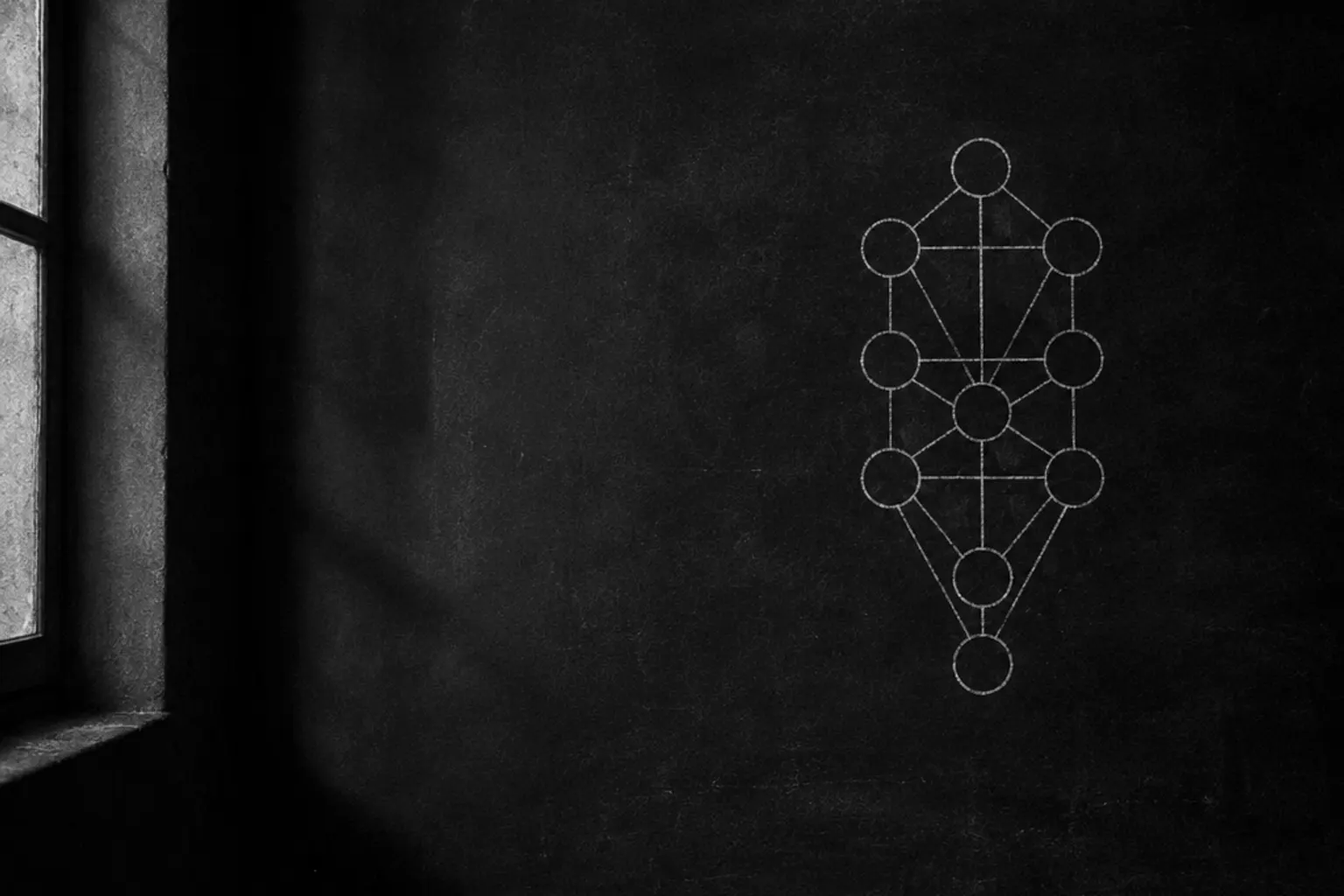
The ten Sefirot as a map for life and business.
A simple, non-academic introduction: ten axes, each in a line or two, and where it meets your day.

Kabbalah · 3 min read
Your desire isn't accidental.
Kabbalah teaches that the filling comes before the desire. What that can change in your relationship to what you want.